ශ්රී ලංකා ප්රජාතාන්ත්රික සමාජවාදී ජනරජයේ තානාපති සහ නිත්ය නියෝජිත කාර්යාලය, බැංකොක්, තායිලන්ත රාජධානිය
இலங்கை ஜனநாயக சோசலிச குடியரசின் தூதரகம் மற்றும் நிரந்தர வதிவிடம், பாங்கொக், தாய்லாந்து இராச்சியம்
The Embassy and Permanent Mission of the Democratic Socialist Republic of Sri Lanka, Bangkok, Kingdom of Thailand

Thailand Trade Relations
Economic and social Indicators - Thailand and Sri Lanka
| Thailand | Sri Lanka | |
| Official Name | Kingdom of Thailand | Democratic Socialist Republic of Sri Lanka |
| Area | 513,120 sq. km | 65,610 Sq. Km |
| Capital | Bangkok | Sri Jayewardenepura Kotte |
| Population | 69,920,998 (2024 est.) | 21,982,608 (2024 est) |
| Life Expectancy | 78.2 years (2024 est.) | 76.8 years (2024 est.) |
| Literacy | 94.1% (2021) | 93.3% (2021) |
| Ethnic Groups | Thai 97.5%, Burmese 1.3%, other 1.1%, unspecified <.1% (2015 est.) | Sinhalese 74.9%, Sri Lankan Tamil 11.2%, Sri Lankan Moors 9.2%, Indian Tamil 4.2%, Other 0.5% (2012) |
| Religions | Buddhist 92.5%, Muslim 5.4%, Christian 1.2%, other 0.9% (includes animist, Confucian, Hindu, Jewish, Sikh, and Taoist) (2021 est.) | Buddhist 70.1%, Hindu 12.6%, Muslim 9.7%, Christian and Roman Catholic 7.6% (2012) |
| GDP | USD 514.94 billion (2023 est.) Source World Bank | $ 84.36 billion (2023) Source World Bank |
| GDP – Rate | 1.88% (2023 est.) Source World Bank | -2.3% (2023) Source World Bank |
| GDP-Per Capita | USD 7,171.81 (2023 est.) Source World Bank | $ 3,827.96 (2023) Source World Bank |
| GDP Composition by Sector | Agriculture: 8.6%
(2023 est.) Industry: 32.9% (2023 est.) Services: 58.5% (2023 est.) | Agriculture:
8.3% (2023 est.) Industry: 25.6% (2023 est.) Services: 59.9% (2023 est.) |
| Labor Force | 40.814 million (2023 est.) | 8.707 million (2023 est.) |
| Unemployment Rate | 0.91% (2023 est.) | 6.36% (2023 est.) |
| Inflation Rate | 1.23% (2023 est.) | 16.54% (2023 est.) |
| Agriculture Products | sugarcane, rice, cassava, oil palm fruit, maize, rubber, tropical fruits, chicken, pineapples, fruits (2022) | Tea, Rubber, Coconuts, Rice, Sugarcane, Spices, Fish, Maize, Fruits and vegetables, Milk and poultry (2023) |
| Industries | tourism, textiles and garments, agricultural processing, beverages, tobacco, cement, light manufacturing such as jewelry and electric appliances, computers and parts, integrated circuits, furniture, plastics, automobiles and automotive parts, agricultural machinery, air conditioning and refrigeration, ceramics, aluminum, chemical, environmental management, glass, granite and marble, leather, machinery and metal work, petrochemical, petroleum refining, pharmaceuticals, printing, pulp and paper, rubber, sugar, rice, fishing, cassava, world's second-largest tungsten producer and third-largest tin producer | Processing of rubber, tea, coconuts, tobacco and other agricultural commodities; Clothing and Textiles; Cement and petroleum refining Ship building, Coir |
| Export – Merchandise | $284.562 billion (2023 est.) | $ 11.911 billion (2023) Source World Bank |
| Export – Merchandise & Services | $337.45 billion (2023 est.) | $17.327 billion (2023) Source World Bank |
| Exports Commodities | Machine parts, integrated circuits, trucks, cars, broadcasting equipment (2023) | Garments, tea, precious stones, used rubber tires, rubber products (2023) |
| Exports Partners | USA 18%, China 13%, Japan 7%, Australia 4%, Singapore 4% (2023) | USA 22%, India 7%, Germany 7%, UK 7%, Italy 5% (2023) |
| Imports | $327.008 billion (2023 est.) | $18.823 billion (2023 est.) |
| Imports Commodities | crude petroleum, integrated circuits, natural gas, gold, vehicle parts/accessories (2023) | Refined petroleum, fabric, crude petroleum, packaged medicine, cotton fabric (2023) |
| Import partners | China 26%, Japan 11%, USA 7%, UAE 6%, Taiwan 5% (2023) | India 21%, China 19%, UAE 10%, Singapore 5%, Malaysia 4% (2023) |
Source: The World Fact book
Bilateral Trade
Thailand remains one of Sri Lanka's most significant trading partners within ASEAN and plays an increasingly important role in Sri Lanka's external trade.
Trade with Thailand 2020-2025
| Year | Value - Exports | Growth (%) - Exports | Value - Imports | Growth (%) - Imports | Value - Total Trade Turnover | Growth (%) - Total Trade Turnover | Trade Balance - Values in US$ Mn. | Import Coverage (%) - Values in US$ Mn. |
|---|---|---|---|---|---|---|---|---|
| 2020 | 37.58 | -61.44 | 366.34 | -16.35 | 403.91 | -24.56 | -328.76 | 10.26 |
| 2021 | 51.61 | 37.34 | 397.85 | 8.60 | 449.46 | 11.28 | -346.24 | 12.97 |
| 2022 | 58.82 | 13.97 | 292.68 | -26.43 | 351.50 | -21.80 | -233.86 | 20.10 |
| 2023 | 46.77 | -20.49 | 251.93 | -13.92 | 298.70 | -15.02 | -205.16 | 18.56 |
| 2024 | 41.59 | -11.08 | 301.32 | 19.60 | 342.91 | 14.80 | -259.73 | 13.80 |
| 2025 | 90.23 | 116 | 479.53 | 59.14 | 569.76 | 66.15 | -389.30 | 18.82 |
Source: Sri Lanka Customs
In 2025, total bilateral merchandise trade reached USD 569.76 million, recording an impressive 66.15% growth compared to USD 342.91 million in 2024.
- Sri Lanka's exports to Thailand: USD 90.23 million
- Growth of 116% compared to 2024.
- Sri Lanka's imports from Thailand: USD 479.53 million
- Growth of 59.14% over the previous year.
Thailand ranked as Sri Lanka's 28th largest export destination and 9th largest source of imports in 2025.
Although the trade balance remains in Thailand's favour, the significant increase in Sri Lankan exports demonstrates the growing acceptance and competitiveness of Sri Lankan products in the Thai market and highlights the considerable potential for further expansion.
Major Exports from Sri Lanka to Thailand
Sri Lankan exports to Thailand are increasingly diversified, with strong demand for both traditional and high-value products.
Key export products include:
- Precious and semi-precious stones
- Jewellery
- Ceylon Tea
- Apparel and textiles
- Electrical capacitors
- Electrical wires and cables
- Activated carbon
- Aluminium products
- Wheat flour
- Seafood products including crustaceans
- Mattresses and bedding products
- Miscellaneous manufactured products
In 2025, precious and semi-precious stones accounted for nearly 70% of Sri Lanka's exports to Thailand, reflecting Thailand's position as one of the world's leading gemstone processing and jewellery manufacturing hubs.
Major Imports from Thailand
Thailand is an important supplier of industrial raw materials, machinery, transport equipment, consumer goods and intermediate products required for Sri Lanka's manufacturing and commercial sectors.
Major imports include:
- Commercial vehicles and passenger motor vehicles
- Natural rubber and rubber products
- Plastics and plastic articles
- Industrial machinery and mechanical equipment
- Knitted fabrics
- Iron and steel products
- Food preparations
- Paper and paperboard
- Aluminium products
- Animal feed
- Sugar
- Chemicals and industrial inputs
Scope for further expansion of Sri Lanka’s Exports to Thailand
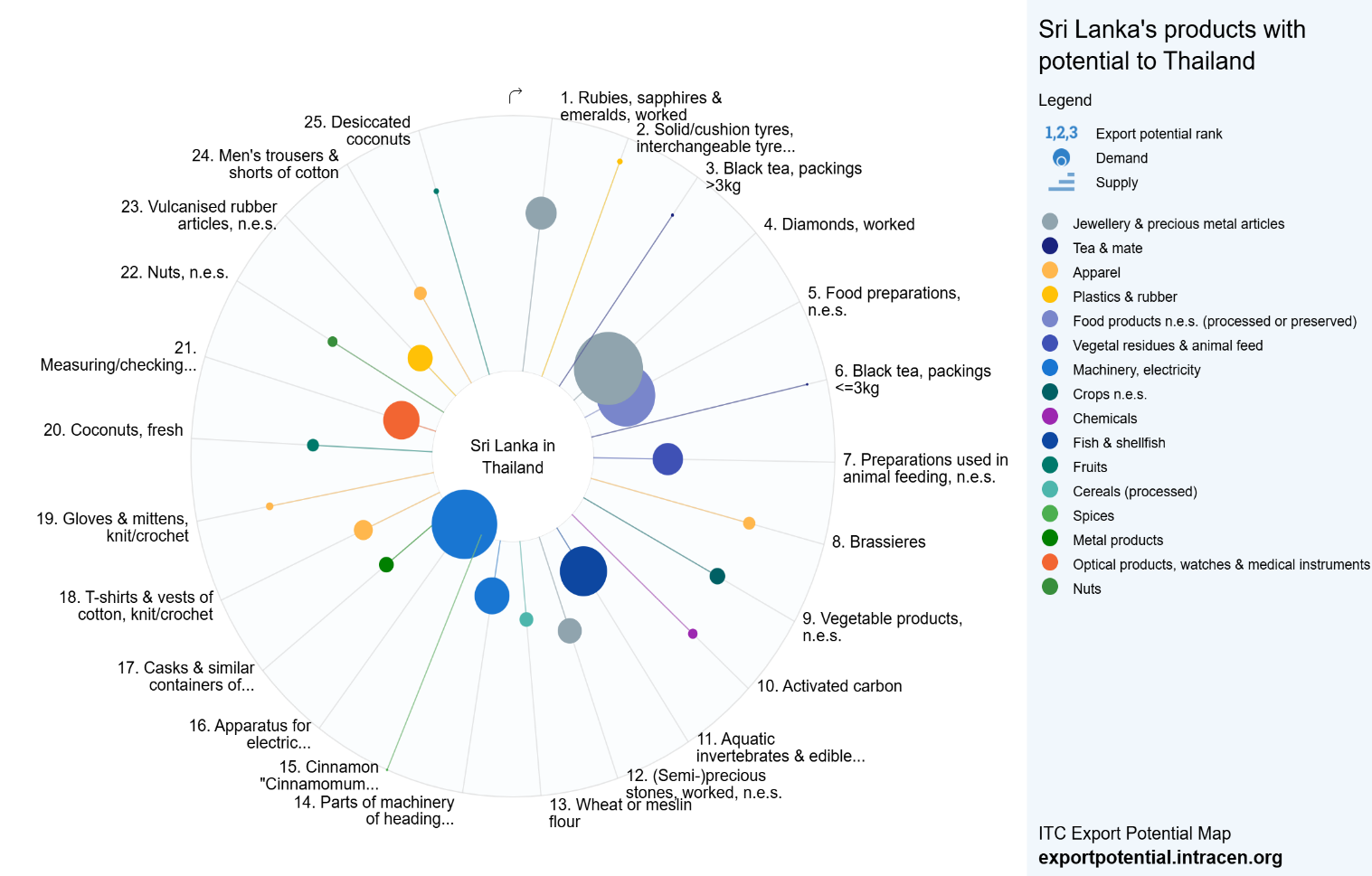
The products with greatest export potential from Sri Lanka to Thailand are Rubies, sapphires & emeralds, worked, Solid/cushion tyres, interchangeable tyre treads/flaps and Black tea packings >3kg. Sri Lanka has the highest supply capacity in Cinnamon "Cinnamomum zeylanicum Blume", fresh. Diamonds, worked is the product that faces the strongest demand potential in Thailand.
Sri Lanka–Thailand Free Trade Agreement (SLTFTA)
The signing of the Sri Lanka–Thailand Free Trade Agreement (SLTFTA) on 3 February 2024 marked a significant milestone in bilateral economic relations.
The Agreement is expected to enhance market access, reduce tariff and non-tariff barriers, improve customs cooperation, strengthen investment flows, and create new opportunities for businesses in both countries.
The SLTFTA covers a broad range of areas including:
- Trade in Goods
- Rules of Origin
- Trade in Services
- Investment
- Customs Procedures and Trade Facilitation
- Sanitary and Phytosanitary Measures
- Technical Barriers to Trade
- Trade Remedies
- Intellectual Property
- Economic Cooperation
- Transparency
- Dispute Settlement
The Agreement is expected to further integrate Sri Lanka into regional value chains and strengthen economic connectivity between South Asia and ASEAN.